Showing posts with label Who hearts. Show all posts

Monday, September 24, 2012

Back Beats

Spoiler alert! This article contains some spoilers for The Power of Three. You have been warned.

There were some good moments in the latest Doctor Who story - The Power of Three, although it was basically a kiddie friendly version of Clive Barker's Hellraiser. What stood out for me was, of course, the stuff about hearts and the Doctor's dual cardiovascular systems. As UNIT descended upon the Ponds' house Kate Stewart identified the Doctor by his dress sense and then confirmed this with a hand held heart scanner producing a wonderful screen shot. (Click on the image for a larger picture.)


There we are, a nice colour image of two hearts. Unlike some of the previous images we have seen the hearts are shown arranged one above the other rather than side by side. We also see what could be lungs highlighted in blue, or this may be the Doctor's famous respiratory bypass system - a convenient "get out of jail card" for the writers on several occasions. There are also some rather truncated ribs which are helpfully kept out of the way of our view of the middle. Quite how this scanner manages to show them at the sides and not where they meet at the breastbone is a mystery but UNIT get all the cool toys.

Things take a turn for the worse when the mysterious cubes stop a lot of people's hearts. This also affects the Doctor's left heart and he struggles to continue with just one side beating. As his condition deteriorates Amy takes matters into her own hands and grabs a conveniently placed defibrillator from a hospital corridor. She shocks the Doctor and restarts his left heart. The reinvigorated Doctor can then program the cubes to act as some form of mass defibrillator and restart the hearts of all the affected humans. Happy endings all round.


Unfortunately this plot device makes the usual television error about what defibrillators actually do. When the heart is fibrillating it means that the muscle is contracting in an uncoordinated fashion and not pumping blood effectively. If you could look directly at a fibrillating heart it would be quivering rather than contracting regularly. Defibrillation applies an electrical shock which basically resets the electrical system of the heart and hopefully gets it contracting properly. If the fibrillation continues unchecked then eventually the heart stops altogether, at which point an electrical shock is going to make no difference at all. Sadly you can't "jump-start" a stopped heart with a defibrillator.

The Doctor's heart and the hearts of a third of the world's population have stopped. Defibrillation will not restart them. In fact using the defibrillator as Amy does would actually risk causing fibrillation in the Doctor's other heart. It is also interesting that the machine she uses is a rather old fashioned model that would only be used by doctors (of the human kind) or trained paramedics. You are much more likely to see something called an Automated External Defibrillator in public places or hospital corridors.

There is another problem. When the Doctor's left heart stops he still has his right sided organ to continue pumping blood to his brain. The humans who we see collapsing all around the world do not have this luxury. While their hearts are stopped no blood is getting to their brains so they are all at risk of serious brain damage. Unless I missed the bit where the Doctor managed to go back in time and somehow restart their hearts immediately after they collapsed then I don't think we would see people just standing up and carrying on as if nothing had happened.

However, the misconception about defibrillation is very common in film and television so the writer can perhaps be excused for making the same mistake. At least this episode gave us a nice view of the Doctor's two hearts. It also get brownie points for introducing Kate Stewart who I hope we see more of, and for mentioning the Zygons. Apart from that I found all the stuff about the Doctor living with the Ponds rather dull and that combined with the poor medicine made it rather a weak story for me. We shall see if the Weeping Angels can save the current series.


Thursday, March 29, 2012

Pan and scan

More scans of the Doctor's chest.
This time it was the Big Finish forum which pointed out that the Ninth Doctor is x-rayed by Henry Van Statten in the episode Dalek. While Rose meets the chained Dalek the Doctor is stripped to the waist, strung up and scanned with something that looks a huge laser. Apparently this is a very painful procedure and while the Doctor screams Van Stratten marvels at the "binary vascular systems" which are shown in this scan. Click the image for a slightly larger version.
The scan is an odd mixture of echocardiogram and x-ray but it gives us just about everything we want to see. This time we get two beating hearts. They look a little small and high in the chest but that may be Gallifreyans for you.

New Who combines decent budget special effects and a more plausible depiction of anatomy. I still prefer the image from the Caves of Androzani but this is pretty good. However, the search for Doctor Who's radiological images continues, email me if you know of any more.

Wednesday, March 28, 2012

Two Hearts beat as One

Doctor's log supplemental:
Over on the British Invaders Facebook page I asked for any other examples of Doctor Who having an x-ray. Brad Walker and Tony Bellows pointed out there is a scene in episode two of the Caves of Androzani which shows a scan of the Fifth Doctor's hearts. Towards the end of the episode the Doctor and Peri are trying to escape from a cell which is guarded by a vigilant Android with a big gun. The Doctor gambles (correctly as it turns out) that the Android's scanner will be confused by his abnormal anatomy and won't shoot him. As he steps out of the cell the camera switches to give us the Android's point of view and we see this.
Which looks like something called a false colour Echocardiogram where colours are added to a normal ultrasound scan of the heart to represent the different directions of blood flow. We can see two purple and white heart shaped structures. They are in the right place, and they are the correct size and shape. Technically we should see them beating but we can't have everything. The special effects people on Caves of Androzani get  top marks for their depiction of the Doctor's anatomy in 1984. Sadly this was forgotten by the time of the 1996 big budget movie.

Tuesday, March 27, 2012

The Man with X-Ray Eyes

Let me take a moment to deal with the vexed subject of Doctor Who, his two hearts and chest x-rays. I assume that people in all professions have difficulties watching representations of their jobs on film or television. That's certainly the case with me and on screen doctors. It is, of course, great fun watching them make schoolboy errors or spouting techno-babble, and there are few things I like more than making a diagnosis before my television counterparts.

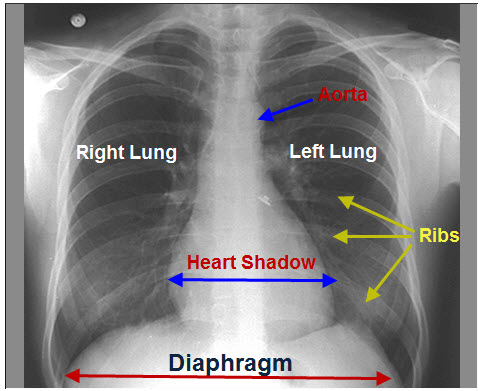
There are three basic errors that seem to be almost universal. The first is the inappropriate use of head mirrors which is best dealt with by my American colleague Scott in his blog. The second is wearing stethoscopes back to front which I might blog about another time. And the third is displaying chest x-rays the wrong way round, which will bring us to Doctor Who. First let's look at a normal chest x-ray and the structures visible. Here is a nice labelled example.
The heart is a big solid lump of muscle and does show up with the low dose of x-rays used to image the chest. You will notice that the left lung is shown on the right of the picture and that most of the heart is on the same side. Chest x-rays are always looked at like this so that what you are seeing corresponds with the front of the patient as you look at them. Now the one thing that isn't shown on the above image is the side marker. It is quite important to know that you have the x-ray film the right way round so the radiographers who take the pictures put a radio-opaque label on the film before pressing the magic button. You can see the side marker in this image.
Having a side marker is crucial in diagnosing a rare condition called Dextrocardia where the heart (and possibly other internal organs) are on the opposite side. Here is an x-ray showing Dextrocardia and notice the side marker.
But of course these side markers can cause confusion and when actors are called upon to put a chest x-ray up on a light box they usually assume that right means right and so put the film up with the R marker on the right hand side. The most infamous example is the title sequence for the medical comedy Scrubs.


Apparently so many medics complained about this that eventually Scrubs included a joke about it and had a character correct the error.

So last night I was watching Paul McGann as the Eighth Doctor in the 1996 TV movie. The film starts with Sylvester McCoy's Seventh Doctor being shot and the struggles of the emergency room physicians to save him before he apparently dies only to later regenerate while in the mortuary fridge. Now as we all know Time Lords from Gallifrey have two hearts and lots of other physiological differences from humans. The Doctor's chest x-ray is put up on a light box and the on-screen medics notice that this shows two hearts and put this down to something they call a "double exposure". This is just medical techno-babble that doesn't really mean anything. But let us examine the x-ray as shown in the film.
Here we can see a single heart shadow which is on the right hand side so either the emergency room medics have put the film up the wrong way round or the Doctor has Dextrocardia (I suspect the former). Then there are the two white shadows in the middle of the lung fields that the screen doctors call hearts. They are the wrong shape and in the wrong place. They look more like hilar shadows which would indicate a whole different set of problems for the Doctor.

I posted a brief comment about this on my Facebook page last night and Brian from British Invaders asked if the scene from Spearhead in Space was any better. This was the story which introduced Jon Pertwee as the Third Doctor in 1970. Interestingly this also showed the Doctor recovering from his regeneration in a hospital. Once again he has a chest x-ray which is supposed to show his two hearts, this time the screen doctor assumes that someone in the x-ray department is playing a joke on him and goes off to remonstrate with them leaving a nurse (and us) to look at this x-ray.
This looks like an artist's impression of a chest x-ray and the staggering thing about it to medical eyes is that it shows no hearts at all! The two dark circles at the top of the chest cavity are what the Spearhead doctor thinks are hearts but again they are wrongly placed, sized and coloured. They should be white shadows where the x-rays have not penetrated to the photographic film. So the simple answer to Brian's question is that the props department and the actors in Spearhead in Space were no better with x-rays than their technologically advanced, but equally incompetent, successors in the 1996 TV movie.

All they need is to have a real medical doctor on set to put them right about all this stuff. It would only take a few minutes and I could spend the rest of my time blogging about it!